 Back
Back




What types of traffic do you work?
How did you find out about us?


 Use this button to Sign In a OceanSpin partner account.

Use this button to Sign In a Jungliwin partner account.

Use this button to create OceanSpin a partner account.
Use this button to create Jungliwin a partner account.
 20 FEBRUARY 2026

Every long-term partnership eventually faces a stress test.
In affiliate marketing, those moments rarely look dramatic from the outside. No one makes a dramatic announcement when things fall apart. You start seeing warning signs: traffic stops running, payouts don't arrive on time, managers go silent, and someone posts a public accusation of non-payment.
This is what a crisis in a partnership looks like in affiliate marketing. As in real life, how you handle a crisis often determines whether the partnership collapses or strengthens.
Let's start with an uncomfortable truth: risks exist on both sides. Affiliates sometimes encounter scams — delayed payments, disappearing managers, and vague explanations of "invalid" traffic. In those situations, frustration is understandable, and public escalation can happen fast.
At the same time, partnerships can freeze not because someone decided to cheat, but because the data raises serious concerns. Fraud traffic, motivated flows, bonus abuse, and multi-accounting — these directly affect product economics and long-term sustainability. What appears to be strong performance on the affiliate side may show up as abnormal behavior patterns in analytics.
We have also encountered situations in which we paused payouts during traffic quality verification, and partners made public accusations before we completed the full analysis. From the outside, it may appear to be a refusal to pay. Inside the system, it is often risk management.
The core issue is rarely the disagreement itself. The real problem begins when structured dialogue stops and both sides rely on assumptions rather than data.
One of the biggest misconceptions in affiliate disputes is the assumption of intent.
A buyer can send traffic that, later, triggers fraud flags even if they did not intend to commit fraud. Many affiliates work through buyer teams or third-party traffic providers. Sometimes affiliates sell traffic services to brands without fully controlling all traffic sources. Mistakes happen. Misjudgments happen. Algorithmic shifts happen.
When something goes wrong, the worst possible reaction is immediate escalation.
Accusations, public posts, and emotional claims rarely resolve the issue. In fact, they often close the door to resolution.
Strong partnerships work differently. They treat anomalies as signals for investigation, not as immediate proof of bad faith.
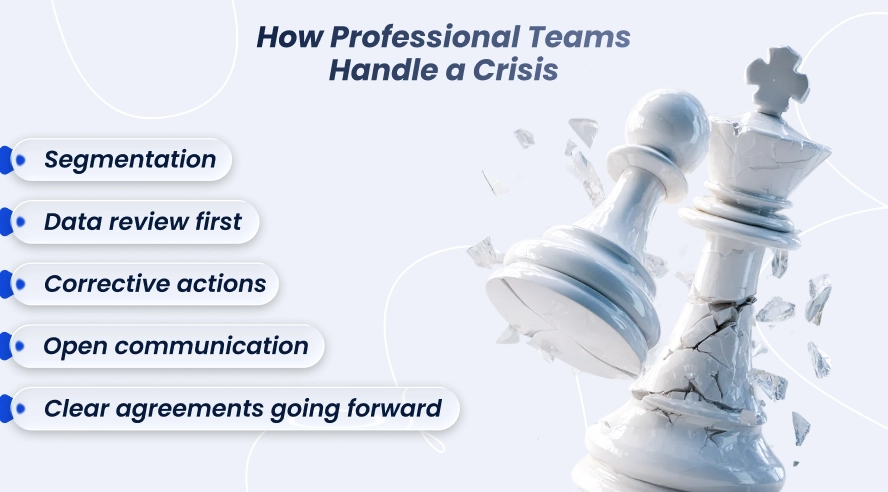
When suspicious patterns appear, professional teams follow process, not emotion.
In our experience, both sides resolve most crises when they review the numbers objectively and stay focused on the data.
Motivated traffic is a sensitive topic because, on the surface, it often looks impressive: fast conversions, immediate deposits, and KPIs achieved. In CPA models, this type of traffic can even pass initial validation checks.
In a RevShare environment, though, motivated traffic rarely creates long-term value. These users typically do not retain, extract bonuses, and exit quickly, which directly impacts retention metrics. What may appear externally as a "refusal to pay" can internally reflect structural risk identified in analytics.
We do not label every anomaly as fraud. We analyze patterns carefully — such as duplicate devices, synchronized sessions, and anomalous deposit behavior. This is not about distrust; it is about protecting sustainable product economics.
Another version of crisis happens in silence.
You send traffic. KPIs were agreed. Suddenly, the manager stops replying. Payout dates shift. Communication becomes vague.
Here, too, the solution is not escalation — it is structure.
Ask for:
Professional networks operate with transparency. If transparency is impossible to obtain, that in itself becomes a strategic signal.
Not every partnership survives a crisis, and not every one should. Conflicts often reveal mismatched expectations, weak processes, or structural risks on either side. Yet when handled correctly, a crisis can strengthen cooperation rather than end it.
We have faced public accusations, misunderstandings, and disputes over traffic quality. Transparent data and open dialogue resolved some of these situations. Others pushed us to tighten validation standards and improve communication. The lesson is clear: the market remembers headlines, but professionals focus on details.
Affiliate marketing runs on trust, but trust without structure is fragile. Clear validation rules, transparent analytics, agreed fraud definitions, defined response times, and escalation channels create stability. A crisis does not automatically mean someone is a scammer; more often, it signals misalignment that needs correction.
At Stars Partners, we build partnerships around transparency, aligned incentives, and structured processes from day one. Sustainable growth depends not on perfect launches, but on how partners handle complexity together.