 Back
Back


×


 Use this button to Sign In a OceanSpin partner account.

Use this button to Sign In a Jungliwin partner account.

Use this button to create OceanSpin a partner account.
Use this button to create Jungliwin a partner account.
 03 JUL 2026
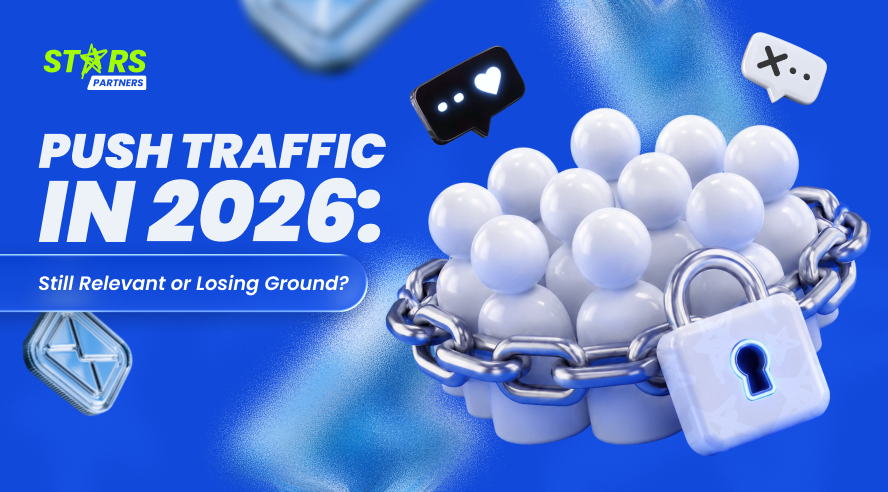
Push traffic has been part of affiliate marketing for more than a decade. It has gone through periods of rapid growth, market saturation, and constant predictions that it would soon disappear. Yet the affiliate industry itself continues to expand.
According to IREV's Affiliate Marketing Statistics 2026, the global affiliate marketing industry is projected to reach $31.7 billion by 2031, highlighting continued investment in performance-based acquisition channels. In 2026, push advertising remains an active source of traffic.
Rising competition, stricter browser policies, higher user expectations, and smarter optimization tools have changed how affiliates approach push campaigns. Today, success depends less on sending millions of notifications and more on choosing the right audience, timing, creatives, and offers.
For media buyers willing to adapt, push traffic still deserves a place in the testing strategy.
Over the past few years, many affiliates have expanded into social media, native advertising, and search. Meanwhile, push traffic has adapted to changing market conditions rather than fading away.
According to recent industry data, more than 96% of browsers now support the web push standard, potentially allowing web push notifications to reach around 85% of internet users.
One of the biggest changes has been the widespread adoption of in-page push notifications. Unlike traditional browser push notifications, they do not rely on browser subscriptions and can appear on most devices and in most browsers. This has helped advertisers maintain reach despite increasing browser restrictions.
Push traffic also continues to attract advertisers because of its relatively low entry cost. Compared to highly competitive channels, campaigns can often be launched with smaller testing budgets while still generating meaningful data.
The speed of campaign launches remains another advantage. Media buyers can test new creatives, offers, and audience segments within hours, rather than waiting days for approval or learning phases.
Push traffic is no longer a universal solution for every vertical or campaign goal. Instead, it performs best in situations where users are already familiar with online offers and can make decisions quickly.
Some of the strongest use cases include:
Rather than replacing other channels, push advertising often works as an additional source that helps diversify traffic and reduce dependence on a single acquisition strategy.
The biggest misconception about push traffic is that it has become ineffective. In reality, many of the strategies that worked several years ago simply no longer produce the same results.
Generic headlines, misleading creatives, and broad targeting have become less effective as users receive more notifications every day. Competition for attention has increased across every advertising channel.
Creative quality has become one of the main performance factors. Notifications need to communicate value immediately without relying on exaggerated promises or clickbait.
Audience segmentation is equally important. Running identical campaigns across every GEO, device, or operating system rarely delivers sustainable results. Successful affiliates continuously analyze performance data and adjust campaigns based on user behavior.
Frequency management also matters more than ever. Sending too many notifications may increase impressions while reducing engagement and overall campaign profitability. Industry research shows that excessive notification frequency is one of the leading reasons users turn off push notifications, making timing and message relevance critical performance factors.
Modern push campaigns rely heavily on automation and data-driven optimization.
Most experienced media buyers use tracking platforms, automated bidding strategies, conversion-based optimization, and real-time performance monitoring. Instead of manually adjusting every campaign, they let data guide budget allocation toward higher-performing placements and audiences.
Artificial intelligence is also becoming part of campaign optimization. AI-assisted creative generation, predictive bidding, and automated audience analysis help reduce testing time while improving decision-making.
However, automation does not replace strategy. Strong campaign performance still depends on understanding user intent, selecting suitable offers, and continuously testing new ideas.
The affiliates achieving consistent results are usually those who treat optimization as an ongoing process rather than a one-time setup.
The answer depends on expectations. Push traffic is unlikely to generate effortless profits through simple mass campaigns. Those days are largely over. But affiliates looking for affordable testing opportunities, additional traffic diversification, and scalable optimization can still achieve strong results.
The most successful media buyers rarely depend on a single traffic source. Instead, they combine push traffic with native advertising, paid social, search, and other acquisition channels to build more stable campaigns.
This diversified approach reduces risk while creating more opportunities to discover profitable audience segments.
Push traffic should no longer be viewed as an outdated channel or a shortcut to quick wins. It has matured into a specialized performance tool that rewards careful optimization and disciplined testing.
Push advertising still delivers results, but only with the right strategy. Keep testing, optimize continuously, and build stronger campaigns by combining multiple traffic sources with Stars Partners.