 Back
Back

×


 Use this button to Sign In a OceanSpin partner account.

Use this button to Sign In a Jungliwin partner account.

Use this button to create OceanSpin a partner account.
Use this button to create Jungliwin a partner account.
 17 JUL 2026
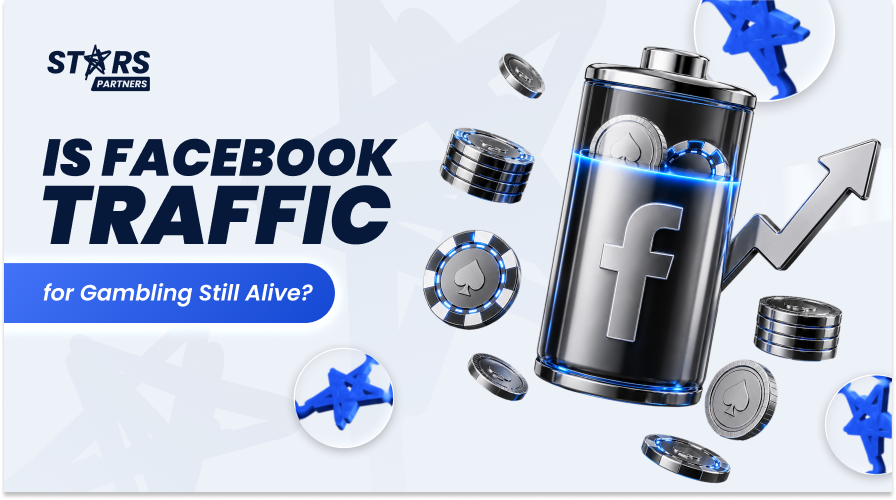
Facebook has been declared "dead" for gambling affiliates more than once. Rising CPMs, stricter moderation, and frequent account bans have pushed many media buyers toward other traffic sources. Yet the numbers tell a different story.
According to Statista, Meta generated more than $196 billion in advertising revenue in 2025, while its family of apps reached 3.56 billion daily active users.
At the same time, 36% of marketers still consider Facebook one of their most important social media platforms in 2026. Those figures make one thing clear: the audience hasn't disappeared. The way advertisers reach it has changed.
Facebook remains one of the largest paid traffic platforms in the world. Statista also estimates that global spending on social media advertising will reach $338.75 billion in 2026, growing by nearly 12% year over year. Brands continue increasing their investment because social advertising still delivers measurable results.
For affiliates, however, scale no longer guarantees profitability. The platform has become significantly more competitive, driving higher acquisition costs across many verticals. Success depends less on budget size and more on campaign quality, testing, and compliance.
The biggest challenge isn't finding users — it's navigating Meta's increasingly strict policies.
A Reuters report published in January 2026 highlighted ongoing concerns from the UK Gambling Commission regarding gambling advertisements appearing on Meta platforms. While regulators criticized Meta's enforcement against illegal operators, the report also confirmed an important fact: gambling-related advertising continues to exist on Facebook under tighter scrutiny.
For affiliates and media buyers, this changes the workflow. Instead of relying on aggressive creatives or disposable accounts, successful teams invest more effort into sustainable campaign structures.
Today, effective Facebook campaigns typically focus on:
Execution has become a competitive advantage.
Algorithm updates and AI-powered ad delivery have made Facebook more efficient at identifying user intent. That also means weak creatives lose performance faster than before.
Media buyers who consistently achieve positive ROI rarely rely on a single winning ad. Instead, they build creative pipelines that allow them to launch new concepts every week while analyzing engagement, CTR, and conversion quality.
Testing has shifted from being an optimization tactic to becoming a core part of campaign management.
Facebook traffic is no longer a simple "launch and scale" channel. It rewards experience, disciplined testing, and the ability to adapt quickly to platform changes.
Despite growing restrictions, the fundamentals remain attractive: billions of active users, continuously expanding advertising investment, and sophisticated AI optimization tools create significant opportunities for skilled affiliates.
The question is no longer whether Facebook traffic still works for gambling. The better question is whether your strategy has evolved alongside the platform.
Affiliates who treat Facebook as a long-term performance channel rather than a short-term arbitrage opportunity continue to generate consistent results in 2026.
Stay tuned to Stars Partners for more expert insights, industry analysis, and practical strategies that help affiliates adapt, optimize campaigns, and discover new opportunities for sustainable growth.