 Back
Back



×


 Use this button to Sign In a OceanSpin partner account.

Use this button to Sign In a Jungliwin partner account.

Use this button to create OceanSpin a partner account.
Use this button to create Jungliwin a partner account.
 11 FEBRUARY 2026
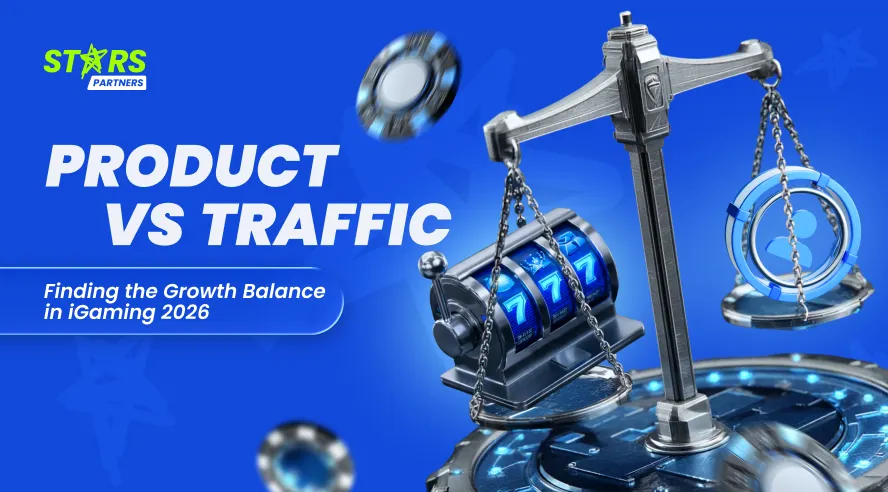
Traffic or product — what really drives growth in iGaming today? In 2026, the old answers no longer work. This article explains how acquisition, product strength, and partnerships must work together to deliver sustainable, scalable results.
By 2026, iGaming will have entered a mature, high-pressure phase where easy growth is no longer available. Competition has intensified across all layers of the ecosystem: more operators fight for the same players, more affiliates compete for the same search demand, and more buying teams chase increasingly limited, scalable traffic sources. Margins that once absorbed inefficiencies are now thin.
At the same time, traffic has become more expensive to operate. SEO requires authority, time, and capital. PPC is not only more expensive but also riskier due to regulatory scrutiny and platform enforcement. Alternative channels demand deeper operational involvement rather than quick tests. Traffic volume without quality now creates downstream problems rather than driving growth.
Players have changed as well. In 2026, they are more experienced, less forgiving, and churn faster. They compare products, notice friction, and expect personalization, speed, and reliability by default. A weak product cannot retain even premium traffic, while a strong product without consistent quality traffic struggles to scale.
This shift forces the market to rethink old growth assumptions.
In 2026, traffic volume lost its decisive power. Scale without quality now amplifies weaknesses instead of revenue. Low-intent users inflate acquisition numbers but fail to convert into long-term value, creating pressure on marketing budgets and partner relationships.
Without a strong product layer, traffic results in a short, shallow lifecycle. Weak onboarding, generic bonuses, slow UX, or poor retention mechanics lead to low LTV, regardless of how efficient the acquisition source looks on paper.
Player behavior has also changed. Users churn faster, test multiple brands in parallel, and abandon platforms after the first signs of friction. In this environment, traffic is no longer a lever for growth in itself — it only delivers results when the product is ready to absorb and retain it.
In 2026, the product will define how far growth can go after the acquisition. A competitive assortment is no longer enough on its own — players expect relevance, freshness, and clear differentiation. Exclusive games, tailored content blocks, and mechanics that feel intentional give users a reason to stay rather than rotate between brands.
Equally critical is operational trust. Fast withdrawals, predictable payout flows, and responsive support directly influence retention curves. Delays or uncertainty break confidence faster than any failed campaign.
When players control their funds and receive responsive support, they engage more actively and generate higher lifetime value. At scale, these product fundamentals compound into sustainable growth rather than one-off spikes.
Even the strongest product hits a ceiling without steady traffic. In iGaming, growth depends on acquiring new users; without it, active player counts stagnate and revenue plateaus.
Operators that rely on a single acquisition channel face constant supply volatility and rising costs. Dependence on organic search, affiliates, or paid advertising limits scalability and weakens long-term growth potential.
With stiff competition for traffic sources and tighter PPC conditions in 2026, diversified acquisition fuel is crucial to unlock the value of product enhancements.
In short, a great product needs reliable traffic flow to scale beyond its initial user base — otherwise growth stalls.
Strong partnerships are a key multiplier for sustainable growth in iGaming — they bridge high-quality traffic with compelling product experiences. First, choosing partners who deliver verified, relevant audiences improves conversion quality and reduces fraud risk, boosting downstream LTV and retention rather than just short-term metrics.
Alignment of values between operators and affiliates ensures that campaigns reinforce brand promise and user expectations, not just clicks. Long-term strategies — like hybrid RevShare/CPA models and co-developed content — foster shared incentives beyond immediate payouts, encouraging deeper collaboration and joint optimisation.
In 2026, the most effective partnerships are those built on mutual trust, aligned goals, and balanced traffic-product synergies that continuously enhance both acquisition and retention outcomes.
In 2026, the focus on top-line traffic metrics is shifting toward performance indicators that demonstrate real business value.
Lifetime Value (LTV) measures the total revenue a player generates — a stronger predictor of sustainable growth than initial conversions alone. High LTV indicates players who return, spend more, and justify premium acquisition costs.
Retention rates indicate how long your product keeps players engaged after their first deposit. A drop from Day 7 to Day 30 highlights product or UX issues that traffic cannot fix.
For partnerships, ROI per partner matters more than raw traffic. Evaluating revenue share, net profit per partner, and cost efficiency helps identify which collaborations truly contribute to the bottom line and warrant long-term investment.
In 2026, growth belongs to teams that align strong products, disciplined acquisition, and trusted partnerships into one system. Extremes no longer scale.
If you already work with high-quality traffic and aren’t partnering with Stars Partners yet, register on our website — we focus on building long-term collaborations that drive predictable, sustainable growth.