 Back
Back




What types of traffic do you work?
How did you find out about us?


 Use this button to Sign In a OceanSpin partner account.

Use this button to Sign In a Jungliwin partner account.

Use this button to create OceanSpin a partner account.
Use this button to create Jungliwin a partner account.
 17 FEBRUARY 2026

Every business relationship starts with a strategic decision, even when no one says it out loud.
Are we entering this collaboration to capture a quick payout and move on, or are we deliberately building a structure that will generate value over time?
In affiliate marketing — particularly in iGaming — this choice is not philosophical; it directly shapes the financial outcome. The way you launch a campaign determines if you generate a single transaction or build a predictable, compounding income stream that grows month after month.
Short-term models naturally appear attractive because they promise clarity and speed. Structures offer immediate feedback, defined KPIs, and fast payouts.
Sustainable growth rarely emerges from isolated actions. It results from deliberate alignment among traffic strategy, product mechanics, and retention systems within a unified framework. When these elements operate independently, performance remains fragmented. When they operate in sync, the campaign's underlying economics change entirely.
There is nothing inherently wrong with CPA campaigns; in fact, they can be highly effective within specific objectives. The challenge begins when you rely on this model as your only strategy. In a purely transactional setup, you send traffic to an offer without integrating it into product logic or long-term user engagement.
The campaign may perform, you may hit your KPIs and receive payouts on time, but you often end the player lifecycle right after the first conversion.
Without product reinforcement, contextual bonuses, or retention-driven engagement, the user’s journey frequently concludes after the first deposit. The acquisition effort generates an immediate result, but fails to translate into repeat sessions, behavioral loyalty, or increased lifetime value. As a result, the affiliate or media buyer must continually restart the process, replacing churned players with new ones to maintain revenue levels.
This approach creates structural volatility. Each month effectively resets performance, and revenue depends on continuous acquisition pressure. Risk remains high because there is no accumulated value working in the background. The system produces activity, but not stability. Over time, this cycle limits scalability and reduces the strategic leverage of long-term user retention.
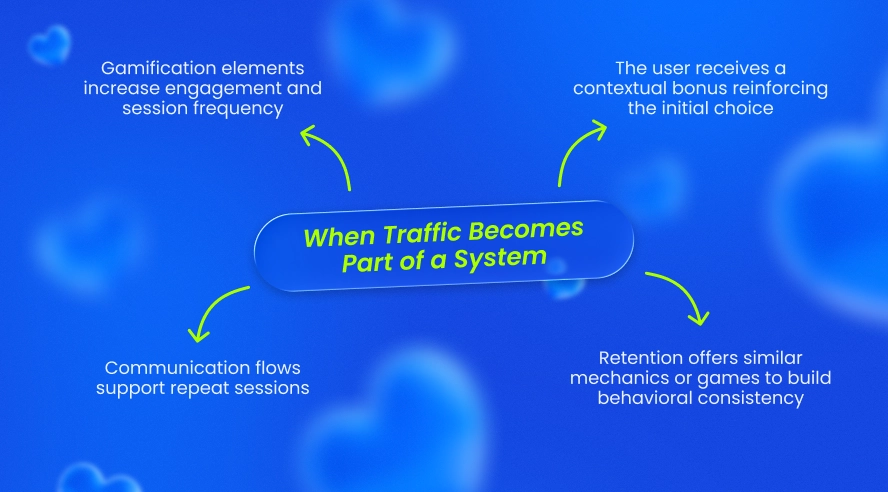
Now let’s look at a different scenario.
Traffic is launched not as a standalone push but as part of a structured funnel.
It starts with a relevant entry point: a specific game, a targeted bonus, a message aligned with player intent. But that’s only step one.
Then the product team continues the logic:
This is not about pushing traffic. It’s about building momentum.
In this model, traffic doesn’t “perform once.” It transitions into retention. And retention transforms into LTV.
The key difference? Synchronization between teams.
Metrics become predictable not because traffic is aggressive, but because product and retention amplify the quality of acquisition. That’s when scale becomes possible.
When product retention is strong and teams operate under a single strategic logic, every quality lead becomes a long-term asset.
This is where RevShare changes the equation.
Unlike CPA, RevShare rewards patience and precision. Instead of a single payout, partners earn a percentage of player value over time. When you align funnels with product and retention strategies, you increase that value over time.
A well-retained player generates:
Yes, RevShare requires confidence in the product. It requires transparency. It requires trust.
When those conditions exist, the upside increases significantly. Playing the percentage game over months, and sometimes even years, can outperform dozens of short CPA bursts.
RevShare isn’t just a payment model. It’s a growth philosophy.
At Stars Partners, we build partnerships designed for long-term profitability rather than one-time gains.
Our real focus is integration: aligning traffic, product logic, retention mechanics, and player journeys into one synchronized system.
For us, RevShare is not just a payout model. It is a growth strategy built on sustainable brand development and partner economics. Traffic may ignite the process, but real scale begins when it becomes part of a structured ecosystem where retention strengthens, metrics stabilize, payouts grow, and trust compounds.
In the long run, this strategic alignment, rather than short-term performance bursts, drives predictable, scalable revenue.